
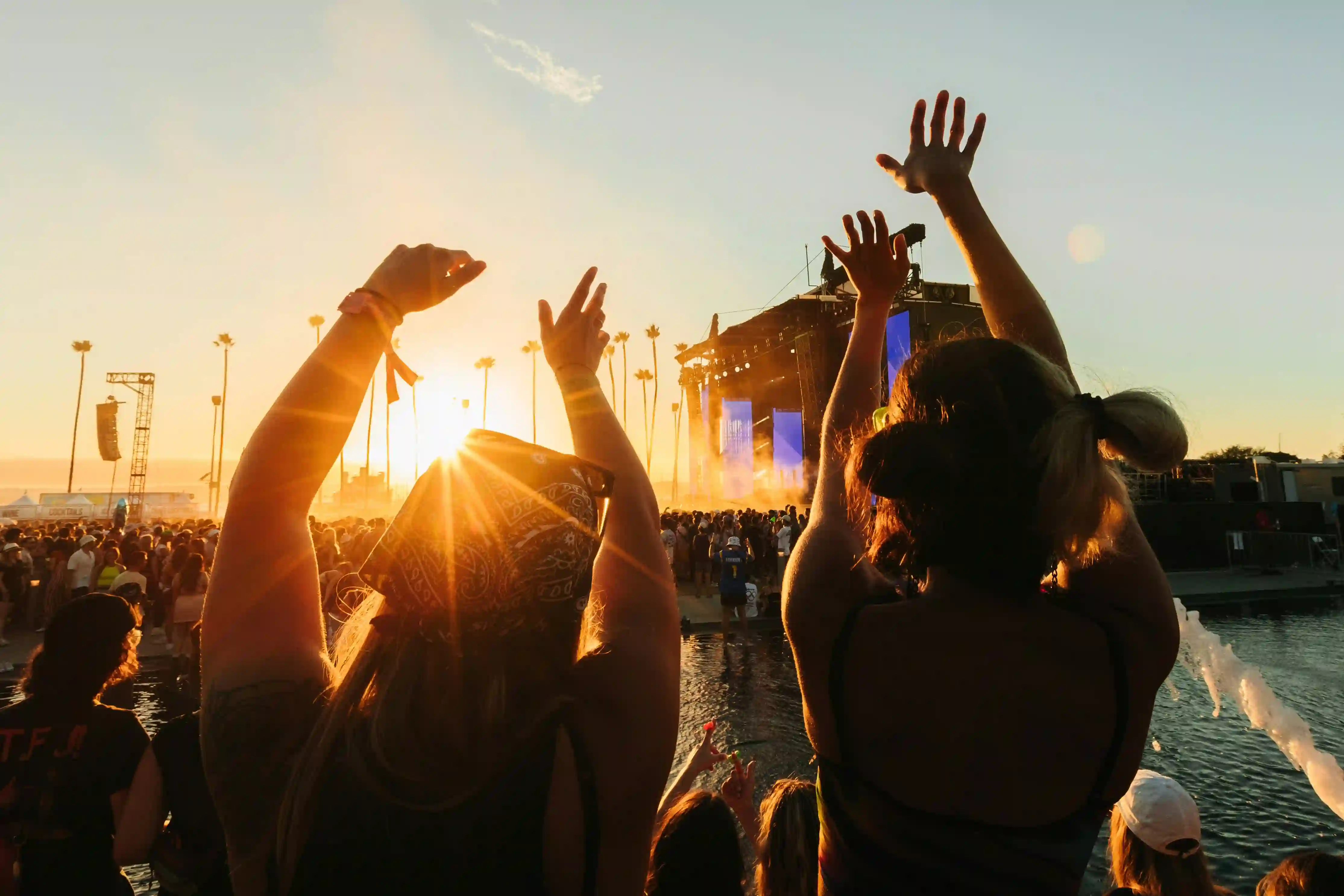

Open up your Instagram feed and spend ten minutes aimlessly scrolling, and the reels of massive crowds with hands in the air, tie-dyed paraphernalia, bucket hats by the thousand, and the obligatory drone shot of a sun-drenched main stage will leave no doubt that festival season is upon us.
All of which got us thinking: what effect do these massive events have on local convenience store tills?
Glastonbury's taking a fallow year, but it's still the UK's biggest tentpole event by a country mile. So we pulled the EPOS data from the convenience stores within ten miles of Worthy Farm to track how the basket moved across three weeks: the week before Glasto 2025, the festival week itself, and the week after.
Overall spend across the area was fairly static BUT the bestseller list went through a serious shakeup: RTDs up 38%, spirits up 28% by value, and vaping's biggest brands up 31%. If you're a brand in alcohol, vaping, confectionery or pharmacy, this is what last year's tills can teach you about playing the next one right.
The booze story is really a format story. The numbers:
Format did the heavy lifting. Thatchers Gold cans climbed 47% even as the cider category as a whole softened. Magnum Tonic Wine jumped 55%. Anything that needed a glass, ice and a mixer got left in the chiller. Anything that you could crack open and glug on the go came out tops.
Lesson learned: ship the format, not the discount.
The vape story comes in two sets. The bigger brands (those with national distribution, sold in 1,000 or more stores) were up 31% in volume and 33% in value during the festival. Include the niche and the local players, and the picture is gentler: roughly 14% on volume, 15% on value. The big names doubled the growth of the smaller ones, two-to-one.
The simplest reading: when you're tired, hungover, in a queue, and the choice in front of you is the brand you've heard of versus the one you haven't, the brand you've heard of wins.
To shoehorn a music metaphor in there: when it comes to vape brands, festival-goers go for hit singles over deep cuts. If you've got the distribution, the festival is when it earns its keep. You're stocked in the shop the customer happens to walk into; the smaller brands often aren't.
Lesson learned: send your headliner to the front of the fixture, not your B-side.
Above the top sellers there's another story, one for shop owners as much as brands. The everyday chart-toppers stayed put: milk, lottery, energy drinks. But underneath them, a distinct festival basket climbed the rankings:
None of this is rocket science. People at a festival want a hot breakfast, fresh breath, a sugar hit, a smoke, a lottery ticket, and a way to get it all home.
The shops that anticipated it sold the products; the brands that anticipated it sold their share. The ones that didn't missed the gig.
Lesson learned: write the setlist before the doors open.
Pharmacy played a show-stopping set, then promptly exited stage left and legged it. Volumes climbed 15% during the week and value 35%: painkillers, plasters, stomach settlers, and the small dignified line of products people forgot to pack.
The next week, volumes crashed 17%. Whatever the customer needed for Saturday at Worthy Farm, they did not need a week later in their own bathroom.
This is the cleanest example in the whole dataset of what event-driven demand actually looks like in convenience: a hard up, a hard down, and very little in between. If you were planning a price promotion that "ran through July" to ride the wave, the wave was a wash by 6 July. The window was the seven days the gates were open.
Lesson learned: pharmacy brands should plan for the week of the festival, not the month afterward.
The week after the festival, when the crowd had packed up and gone home, most of the uplift went with them:
But two categories came back for the encore. Spirits held (flat on volume, +2% value), and the bigger vape brands actually grew (+9% volume and +13% value). With the 200,000-strong crowd back home, the shoppers in these stores that week were almost entirely locals.
Whatever the festival did to these categories in this corner of Somerset, the locals stuck with it: shelves rearranged during festival week, locals trying something new on the back of the influx, or both. The data can't separate them, but a signal that outlives the crowd is worth watching.
Lesson learned: some acts come back for the encore. Find out which ones are yours.
The most useful thing in this whole exercise is what doesn't show up. Total convenience spend across the area was flat: value down 0.5% on the week before. On a national dashboard, you would have seen nothing.
But that "nothing" was two real things cancelling each other out. Temperatures dropped roughly 3.5°C on average between the week before Glastonbury and the festival week itself. That's the kind of swing that pulls ice cream, water and soft drinks down with it. Ice cream −49%, water −22%, soft drinks −11%. At the same time, 200,000 festival-goers showed up and pushed RTDs, spirits, vape and pharmacy up just as hard. Two forces, opposite directions, roughly equal weight, and the headline number landed at zero.
That's why the location-level read matters. A flat total can hide a real weather drag and a real event lift sitting right on top of each other. Without the festival, the area's spend likely would have been down by a noticeable chunk. Without the temperature drop, it likely would have been up. The "normal week" on the dashboard was anything but.
This is one event's worth of data (a sizeable one, but still one event). We're not going to pretend every concert, county show or summer fixture behaves the same way. What we can say is that the questions are the same: what shifts, what doesn't, what sticks, what fades. And the answers live in the till data from the stores around them.
Lesson learned: read the tills, not the totals.
We can help. Retail Spotlight collects data from 13,000+ convenience stores and 1,000+ vape and pharmacy stores across the UK.
Our data is used by leading FMCG brands to understand category performance, track distribution, measure NPD, evaluate pricing, and run targeted activations. Everything we provide is built on clear, consistent, near-real-time data.
If you'd like to know what last summer's events did to your category, what to plan for in the next one, or what the data says about an event we haven't looked at yet, get in touch and we'll help you plan for the next big festival.